
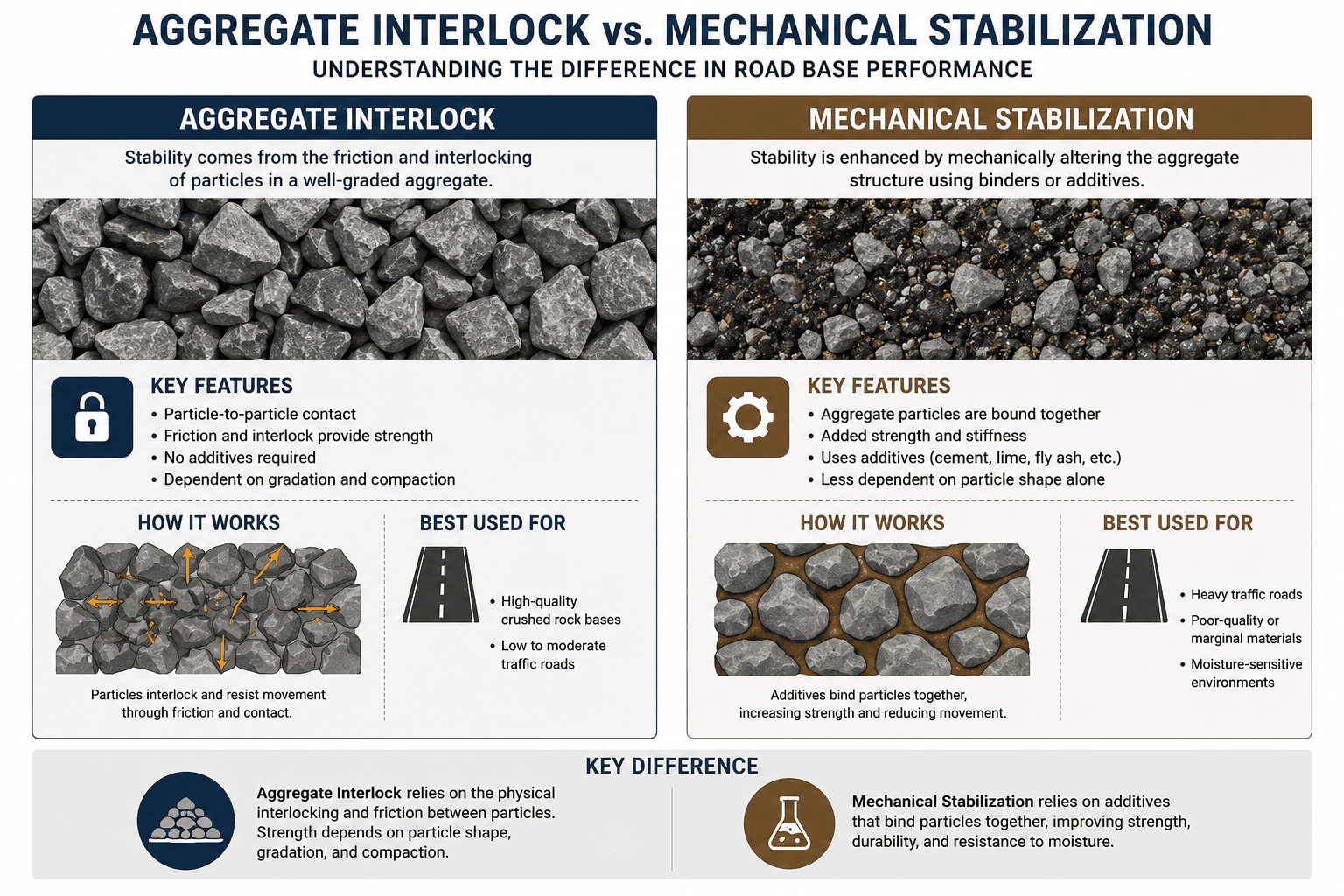
Let us be honest for a second... when we drive on a smooth road, we rarely think about what is going on underneath. We just expect it to feel solid, right? But if we slow down and think about it, the real strength of any road starts way below the surface... especially with the road base material.
Now here is where things get a bit interesting. When people talk about strong road foundations, two ideas often come up... aggregate interlock and mechanical stabilization. They sound a bit technical, maybe even similar. But once we break them down, they are actually quite different... and kind of fascinating too.
So let us walk through it together.
So... What Is Aggregate Interlock?
Picture this. We grab a bunch of crushed stones and pack them tightly together. Not just any stones... rough, jagged ones.
When we press them down, something cool happens. Those sharp edges start catching onto each other... almost like they are holding hands and refusing to move.
That is aggregate interlock.
It is all about how those rough particles grip each other. No glue. No extra materials. Just pure contact and friction doing the job.
And honestly... when it works well, it works really well.
Why does this matter? Because when traffic rolls over the road, those stones are less likely to slide around. They stay put. The whole layer feels solid and stable.
Simple idea... but super effective.
Then What Is Mechanical Stabilization?
Alright, now let us shift gears a little.
Instead of focusing only on how particles lock together, mechanical stabilization looks at how everything fits as a whole.
Think about filling a jar. If we toss in only big rocks, there will be lots of empty gaps. It looks full... but it is not really packed tight.
Now we add smaller stones. Suddenly, those gaps start disappearing.
Then we sprinkle in even finer material. Now everything settles in nicely... tight, dense, and compact.
That is mechanical stabilization in action.
It is not just about shape... it is about mixing different sizes so they fit together better. Less empty space means better support and fewer weak spots.
And yes... that makes a big difference over time.
The Real Difference (Without Overthinking It)
Let us keep this part super simple.
Aggregate interlock is about how particles grip each other.
Mechanical stabilization is about how particles fit together.
One focuses on friction and locking.
The other focuses on density and packing.
Different approaches... same goal... a strong base.
Why Aggregate Interlock Still Matters
We might think... if we are already mixing sizes, do we even need interlock?
Short answer... yes, we do.
Without good interlock, those particles can shift when pressure hits. And roads deal with pressure all day long... cars, trucks, weather... you name it.
Good interlocking helps keep everything steady. It adds that extra bit of strength that stops things from moving around too much.
Kind of like stacking uneven bricks... if they grip each other well, the stack holds better.
Why Mechanical Stabilization Is Just As Important
Now let us not ignore the other side.
Even if particles lock well, gaps can still exist. And those gaps... they can cause trouble.
Water can sneak in. Materials can settle unevenly. Over time, that nice smooth road might not feel so smooth anymore.
Mechanical stabilization helps avoid that.
By filling those spaces, we get a tighter structure. More support. Better performance over time.
It is like making sure there are no hidden weak spots.
Do We Actually Use Both Together?
Oh yes... almost always.
In real projects, it is not about choosing one over the other. That would be like trying to build a house with only walls or only a roof... it just does not make sense.
We usually go for both.
We pick materials that have rough, angular shapes for strong interlock. Then we make sure there is a good mix of sizes to improve compaction.
When these two work together... that is when things really come together.
Strong. Stable. Long-lasting.
Choosing the Right Road Base Material
This part is where it all comes together.
Choosing the right road base material is not just about grabbing whatever is available. There is a bit of thought behind it.
We look at shape. We look at size variation. We think about how it will compact and how it will behave over time.
Because at the end of the day... the goal is simple.
We want a base that holds up. One that does not shift, sink, or break down too quickly.
And when we get both interlock and stabilization right... we are on the right track.
FAQs
1. What is aggregate interlock in road construction?
Aggregate interlock is when rough, angular stones lock into each other after compaction, creating a stable and strong base layer.
2. What does mechanical stabilization mean?
Mechanical stabilization is the process of mixing different particle sizes to create a denser and more compact structure with fewer gaps.
3. Which is more important, aggregate interlock or mechanical stabilization?
Both matter. Interlock gives strength through friction, while stabilization improves density and overall structure.
4. Can a road base perform well without mechanical stabilization?
It might work for a while, but gaps can lead to settling and weaker performance over time.
5. Why is particle shape important in road base materials?
Angular particles grip each other better, which helps prevent movement and improves stability.