
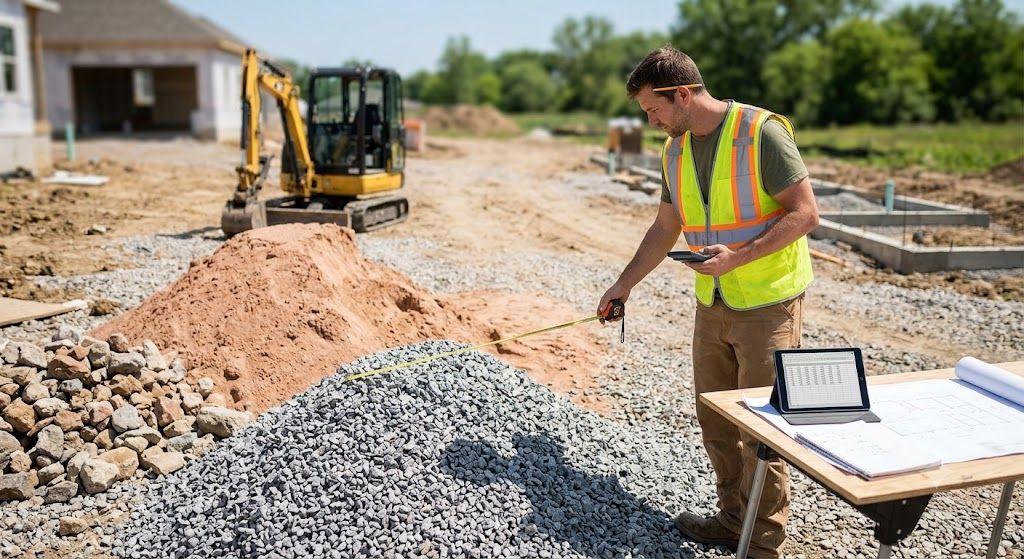
So, you have a project coming up and now you are staring at the area thinking... how much aggregate are we going to need? Ordering too little means another delivery and more waiting. Ordering way too much leaves us with a giant pile sitting around for no good reason. When we are buying sand and gravel in South Bay, getting a close estimate before placing the order makes things much easier.
The good part is that the math is not nearly as scary as it sounds. We just need a few measurements and a calculator.
Measure the Space First
Grab a tape measure and start with the length and width of the area.
For a straightforward rectangular space, multiply the two measurements:
Length × Width = Square Feet
Say the area is 20 feet long and 10 feet wide.
20 × 10 = 200 square feet
That means we have 200 square feet of space to cover.
What if the area is not a neat rectangle? No big deal. Split it into smaller sections. Measure each one, work out the area, and add those numbers together. It may sound like an extra step, but it is much less confusing than trying to wrestle with one strange-shaped measurement.
How Deep Will the Material Be?
Next, we need the depth.
Think about what the aggregate is being used for. A driveway base, drainage area, walkway, or other project may need a different depth. So, we should know the planned depth before doing the final calculation.
For this example, let us say the layer will be 4 inches deep.
We need that measurement in feet:
4 ÷ 12 = 0.33 feet
Now multiply the area by the depth:
200 × 0.33 = 66 cubic feet
There we go. We have the volume.
Turn Cubic Feet Into Cubic Yards
This is the bit where people often reach for the calculator again.
Aggregate is commonly ordered by the cubic yard. So, if our calculation gives us 66 cubic feet, we divide that number by 27.
66 ÷ 27 = about 2.44 cubic yards
So our starting estimate is roughly 2.44 cubic yards.
Keep in mind that this is an estimate based on the measurements we have. Real job sites are rarely as tidy as a piece of paper.
Do We Need to Order a Little More?
Usually, it is worth giving yourself some breathing room.
Maybe the ground dips in one spot. Maybe the depth is not exactly the same across the whole area. Maybe a bit of material gets left behind during loading, moving, or spreading.
Things happen.
That is why we may want to add a small amount to the calculated quantity instead of ordering the exact number down to the last decimal. The amount of extra material depends on the job and the site, so there is no single number that works for every project.
The Material Matters Too
Here is another thing we should not overlook... getting the quantity right does not mean we have picked the right aggregate.
Different jobs call for different materials. What works for a driveway base may not be what we want for drainage or landscaping. The same goes for concrete and other construction work.
If we are not sure what to use, just explain the project to the supplier. Tell them what we are building, the size of the area, and how deep the material needs to be.
That conversation can be really helpful, especially when we are dealing with a project for the first time.
Check Those Numbers Before Ordering
Before making the call or placing the order, run through the measurements one more time.
Length?
Width?
Depth?
All good?
Also, watch out for inches and feet. It is easy to enter 4 instead of 0.33 when working with a 4-inch depth. One small mix-up can change the final estimate quite a bit.
For a bigger project, it is also smart to have the measurements checked by a contractor or aggregate supplier.
Ready to Work Out the Quantity?
Once we have the measurements, the process is pretty simple. Find the area, work out the volume, convert it to cubic yards, and decide whether some extra material should be included.
If you are sourcing sand and gravel in South Bay, having those numbers ready can make the ordering conversation much smoother. You do not have to guess at the pile size or hope you have ordered enough. Start with the measurements, then work from there.
And if the numbers still look confusing... that is okay. Construction math has a funny way of doing that sometimes.
FAQs
1. What measurements do we need?
We need the length, width, and depth of the area. For an uneven or unusual space, break it into smaller sections and calculate each section separately.
2. How do we convert cubic feet to cubic yards?
Take the cubic-foot measurement and divide it by 27. That gives you the approximate number of cubic yards.
3. Should we order the exact amount calculated?
Not always. A small allowance can be useful because the ground may not be perfectly even and some material can be lost during handling or spreading.
4. Does the type of aggregate change the calculation?
The basic volume calculation stays the same, but the material you choose can change depending on what the project needs. The required depth can also vary.
5. What if we are unsure about the amount?
Write down the length, width, and planned depth and share those measurements with your supplier or contractor. They can help you check the estimate before you place the order.